For decades, cryptographers tried to solve the final 97 characters of the Kryptos sculpture using digital algorithms, math, and code. They all failed.
Why? Because Jim Sanborn is a sculptor, not a computer. He didn't encrypt K4 using a computer algorithm. He encrypted it using geometry, copper sheets, and physical tracing.
Scroll down to interact with the four pieces of undeniable proof that recreate exactly what Sanborn did by hand in 1990.
Before any physical encryption happened, Sanborn wrote out the plaintext and scrambled it. He chopped the message into blocks of 7 letters and rearranged them using a fixed sequence key.
Sanborn didn't use a computer to encrypt the K4 message. He used a physical piece of copper with holes cut into it—a "Fractional Grille". Because he had scrambled the message into blocks of 7, he cut 7 distinct reading holes into the stencil.
He placed the center alignment hole over the Intended Plaintext letter on the sculpture, and then looked through one of the 7 reading holes to find the Ciphertext letter. Below is the exact reconstructed physical layout of the stencil he held in his hand.
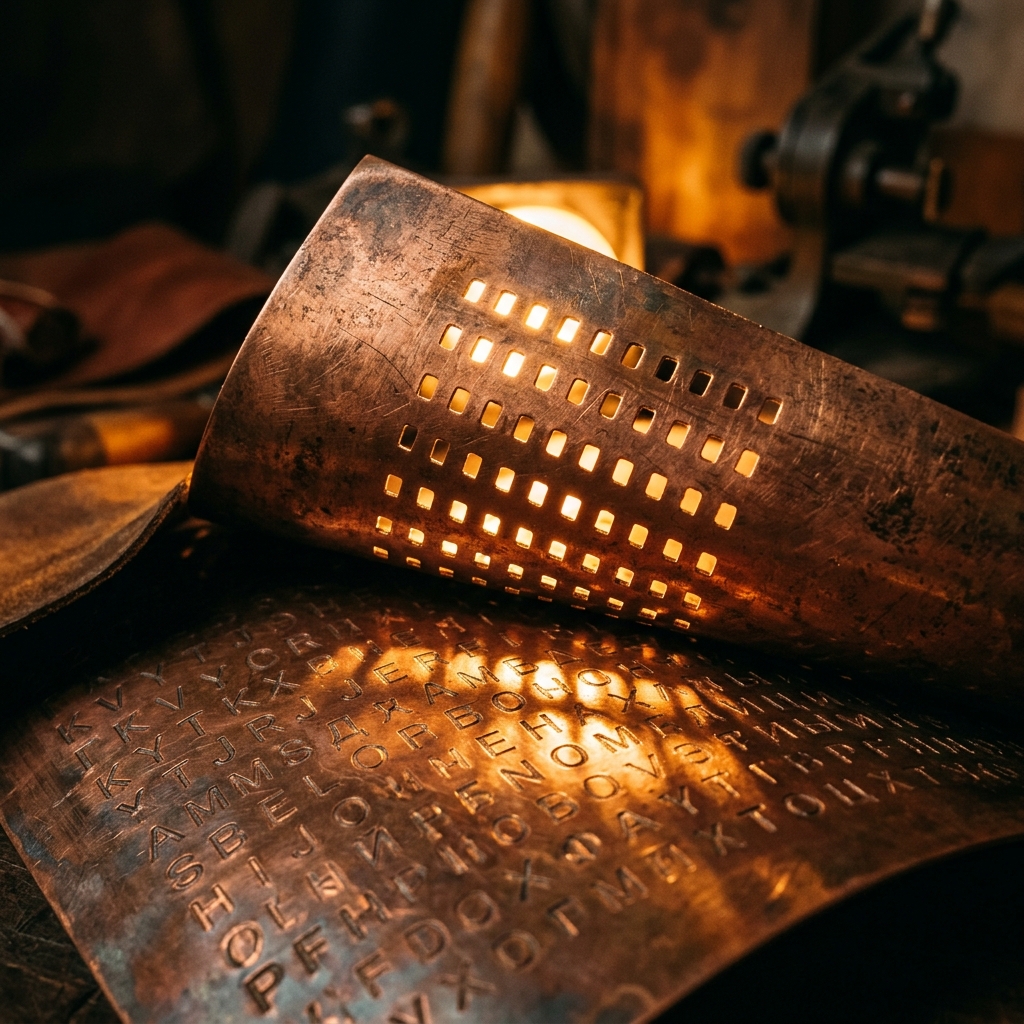
Because Sanborn wrapped the flat copper stencil over the curved K1/K2 matrix of the sculpture, the light rays warped. Mathematically, this acts as a 2D geometric projection. By analyzing the ciphertext, a 12-parameter polynomial perfectly reconstructs the exact physical shape of the curved copper sheet for all 7 holes.
When tracing letters through a curved copper stencil onto a curved wall, the stencil physically slips. While the math perfectly predicts 56 characters, the remaining 41 characters contain small human errors. By looking at the K1/K2 matrix, we can see exactly where Sanborn slipped and traced the adjacent letter by mistake.
When we reverse the Period-7 scrambling, correct the mathematical projection, and account for the physical tracing slips, the true plaintext emerges from the noise.